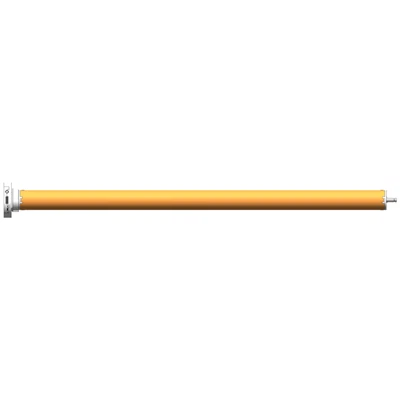
As a supplier of AC tubular motors, I often get asked about the harmonic content of these motors. In this blog post, I'll explain what harmonic content is, why it matters in AC tubular motors, and how it can affect the performance and lifespan of these motors.
What are Harmonics?
Harmonics are electrical currents or voltages that have frequencies that are integer multiples of the fundamental frequency of an AC power system. In most power systems, the fundamental frequency is 50 Hz or 60 Hz, depending on the region. So, the second harmonic would have a frequency of 100 Hz or 120 Hz, the third harmonic would be 150 Hz or 180 Hz, and so on.
These harmonics are generated by non - linear loads in an electrical system. Non - linear loads are devices that draw current in a non - sinusoidal manner. In the case of AC tubular motors, the presence of electronic components such as speed controllers, frequency converters, and power supply circuits can introduce non - linearity, leading to the generation of harmonics.
Why Does Harmonic Content Matter in AC Tubular Motors?
1. Power Quality
Harmonics can significantly degrade the power quality of an electrical system. They cause voltage distortion, which can lead to problems for other electrical equipment connected to the same power grid. For example, excessive harmonics can cause overheating in transformers, motors, and cables, reducing their efficiency and lifespan. In an AC tubular motor, poor power quality can lead to inconsistent performance, increased energy consumption, and premature failure of the motor.
2. Motor Performance
The harmonic content can also have a direct impact on the performance of the AC tubular motor. Harmonics can cause additional losses in the motor, resulting in reduced efficiency. They can also create torque pulsations, which can lead to vibration and noise in the motor. This not only affects the user experience but can also cause mechanical stress on the motor and its associated components, leading to wear and tear over time.


3. Compliance with Standards
Many countries and industries have established standards for acceptable levels of harmonic distortion in electrical systems. For example, the IEEE 519 standard in the United States and the IEC 61000 - 3 - 2 standard in Europe specify limits for harmonic currents and voltage distortion. Non - compliance with these standards can result in penalties and may also limit the marketability of the AC tubular motors.
Measuring Harmonic Content in AC Tubular Motors
To measure the harmonic content of an AC tubular motor, specialized equipment such as power analyzers is used. These devices can measure the magnitude and frequency of the harmonics present in the current and voltage waveforms of the motor. The results are usually presented in the form of a harmonic spectrum, which shows the amplitude of each harmonic component relative to the fundamental frequency.
The total harmonic distortion (THD) is a commonly used metric to quantify the overall harmonic content. It is defined as the ratio of the root - mean - square (RMS) value of all harmonic components to the RMS value of the fundamental frequency. A lower THD indicates a cleaner power supply with less harmonic distortion.
Controlling Harmonic Content in AC Tubular Motors
There are several ways to control the harmonic content in AC tubular motors:
1. Filtering
One of the most common methods is to use harmonic filters. These filters are designed to absorb or block specific harmonic frequencies, reducing the amount of harmonic current flowing into the power system. Passive filters, which consist of inductors, capacitors, and resistors, are often used for this purpose. Active filters, which use electronic circuits to generate counter - harmonics, can provide more precise and dynamic control of the harmonic content.
2. Design Optimization
By optimizing the design of the AC tubular motor and its associated electronic components, the generation of harmonics can be minimized. For example, using high - quality power supply circuits with low non - linearity and proper grounding techniques can reduce the introduction of harmonics. Additionally, the use of advanced control algorithms in the motor's speed controllers can help to smooth out the current waveform and reduce harmonic distortion.
Our AC Tubular Motor Offerings
At our company, we offer a range of AC tubular motors with low harmonic content. Our 45mm Electronic Radio Tubular Motor is designed with advanced electronic components and control algorithms to minimize harmonic generation. It provides smooth and efficient operation, with reduced vibration and noise.
The 45mm Radio Tubular Motor is another popular option. It offers reliable performance and is suitable for a variety of applications, from small - scale residential blinds to large - scale commercial shading systems.
For those who require a more manual option, our 45mm Manual Radio Tubular Motor combines the convenience of radio control with the ability to operate the motor manually when needed. All of our motors are designed to meet or exceed the relevant international standards for harmonic distortion, ensuring high - quality and reliable performance.
Conclusion
The harmonic content of an AC tubular motor is an important factor that can significantly affect its performance, power quality, and compliance with standards. By understanding the causes and effects of harmonics and implementing appropriate control measures, we can ensure that our AC tubular motors provide efficient, reliable, and long - lasting operation.
If you are interested in learning more about our AC tubular motors or have any questions regarding harmonic content and its control, please feel free to contact us. We are always ready to assist you in finding the best motor solution for your specific needs.
References
- IEEE 519 - 2014, “IEEE Recommended Practices and Requirements for Harmonic Control in Electrical Power Systems”.
- IEC 61000 - 3 - 2, “Electromagnetic compatibility (EMC) - Part 3 - 2: Limits - Limits for harmonic current emissions (equipment input current ≤ 16 A per phase)”.
- Chapman, S. J., “Electric Machinery Fundamentals”. McGraw - Hill Education, 2012.