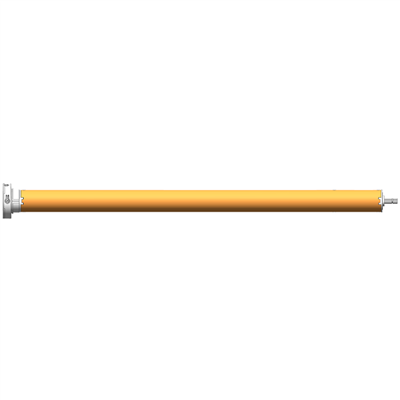
As a core component in modern automation equipment, tubular motors are widely used in electric curtains, sunshade systems, industrial rolling doors and other fields. The refinement and efficiency of its production process directly affect the performance and market competitiveness of the product. This article will comprehensively analyze the production process of tubular motors from raw material preparation to finished product testing.
The first step in producing tubular motors is raw material preparation. The main materials include high-precision silicon steel sheets, high-quality copper wires, insulating materials, and precision bearings. Silicon steel sheets are used for stator cores and need to be stamped to ensure the efficiency of the magnetic circuit; copper wires are used for winding coils, and their purity and conductivity directly affect the efficiency of the motor. Insulating materials such as epoxy resin or polyester film are used for interlayer insulation of coils to ensure safe and reliable operation of the motor.
Next is the manufacture of the stator and rotor. The stator core is formed by stamping and lamination processes, and then the coil is wound. The winding process requires strict control of the number of turns and wire diameter to ensure that the electromagnetic performance meets the design requirements. After winding, the coil needs to be impregnated with insulating paint and dried to enhance insulation and mechanical strength. The rotor part is composed of the shaft core, magnetic steel and bearing. The magnetic steel needs to be accurately magnetized to ensure uniform magnetic field distribution, and the installation accuracy of the bearing directly affects the smooth operation of the motor.
Assembly is a key step in the production process. The stator and rotor need to be accurately assembled in a dust-free environment to prevent dust or metal chips from entering the motor. After assembly, the motor needs to be initially debugged, including power-on test and speed test, to ensure that it runs smoothly and without abnormal noise.
Finally, finished product inspection and packaging. Tubular motors need to undergo a number of rigorous tests, including insulation resistance test, voltage resistance test, temperature rise test and life test, to ensure that they meet international standards. Qualified products will be rust-proofed and moisture-proof packaged for safe transportation to global customers.
Through the above process, tubular motors achieve efficient and stable production, providing reliable power support for automation equipment. In the future, with the advancement of intelligent manufacturing technology, the production process of tubular motors will be further optimized to meet the market demand for higher performance.