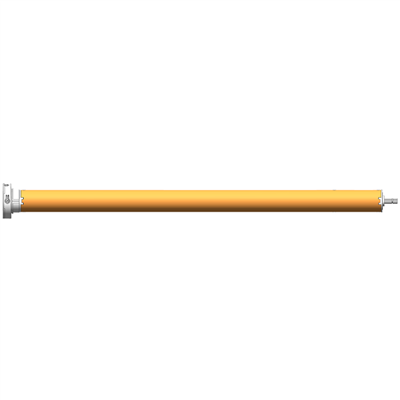
As a supplier of External Venetian Blinds Tubular Motors, I often encounter various technical inquiries from customers. One of the frequently asked questions is about the power factor of these motors. In this blog post, I will delve into the concept of power factor, its significance for external Venetian blinds tubular motors, and how it impacts the overall performance and efficiency of the system.
Understanding Power Factor
Power factor is a crucial electrical parameter that measures how effectively electrical power is being used in an AC (alternating current) circuit. It is defined as the ratio of real power (P), which is the power that actually performs useful work, to apparent power (S), which is the product of the voltage and current in the circuit. Mathematically, power factor (PF) is expressed as:
[PF=\frac{P}{S}]
The value of power factor ranges from 0 to 1. A power factor of 1 indicates that all the electrical power supplied to the circuit is being used effectively to perform useful work, while a power factor less than 1 means that some of the power is being wasted in the form of reactive power. Reactive power is the power that oscillates between the source and the load without performing any useful work, and it is caused by the presence of inductive or capacitive elements in the circuit.
Power Factor in External Venetian Blinds Tubular Motors
External Venetian blinds tubular motors are typically inductive loads, which means they have a power factor less than 1. Inductive loads, such as motors, transformers, and solenoids, require a magnetic field to operate, and this magnetic field stores and releases energy in the form of reactive power. As a result, the current drawn by an inductive load lags behind the voltage, leading to a lower power factor.
The power factor of an external Venetian blinds tubular motor depends on several factors, including the motor design, the load characteristics, and the operating conditions. Generally, the power factor of these motors ranges from 0.5 to 0.8, which means that a significant portion of the electrical power supplied to the motor is being wasted as reactive power.


Importance of Power Factor in External Venetian Blinds Tubular Motors
The power factor of an external Venetian blinds tubular motor is an important consideration for several reasons:
Energy Efficiency
A low power factor means that more electrical power is required to operate the motor, which results in higher energy consumption and increased electricity bills. By improving the power factor of the motor, the energy efficiency can be significantly enhanced, leading to cost savings and reduced environmental impact.
System Capacity
Reactive power takes up valuable electrical capacity in the power distribution system, which can limit the number of motors that can be connected to the system. By improving the power factor, the reactive power demand can be reduced, allowing more motors to be connected to the system without overloading it.
Motor Performance
A low power factor can also affect the performance of the motor, causing it to run hotter, produce more noise, and have a shorter lifespan. By improving the power factor, the motor can operate more efficiently and reliably, leading to better performance and longer service life.
Improving the Power Factor of External Venetian Blinds Tubular Motors
There are several ways to improve the power factor of external Venetian blinds tubular motors:
Capacitor Compensation
One of the most common methods of improving the power factor is to use capacitor compensation. Capacitors are connected in parallel with the motor to counteract the inductive reactance and reduce the reactive power demand. By adding the appropriate amount of capacitance, the power factor can be increased to a more acceptable level.
Motor Design
The power factor of a motor can also be improved by optimizing its design. This can include using high-quality materials, reducing the resistance and inductance of the windings, and improving the magnetic circuit design. By reducing the reactive power demand of the motor, the power factor can be increased, leading to improved energy efficiency and performance.
Load Management
Proper load management can also help to improve the power factor of external Venetian blinds tubular motors. This can include avoiding overloading the motor, using the motor at its rated load, and turning off the motor when it is not in use. By reducing the load on the motor, the reactive power demand can be reduced, leading to improved power factor and energy efficiency.
Our Product Range
At our company, we offer a wide range of external Venetian blinds tubular motors with different power ratings and features to meet the diverse needs of our customers. Our motors are designed to provide high performance, reliability, and energy efficiency, and they are available in various sizes and configurations.
Some of our popular products include the 92mm Manual Override Tubular Motor, the 92mm Standard Tubular Motor, and the 92mm Manual Tubular Motor. These motors are designed to provide smooth and quiet operation, and they are suitable for a variety of applications, including residential, commercial, and industrial buildings.
Conclusion
The power factor of an external Venetian blinds tubular motor is an important consideration for energy efficiency, system capacity, and motor performance. By understanding the concept of power factor and taking steps to improve it, such as using capacitor compensation, optimizing the motor design, and practicing proper load management, the energy efficiency and performance of the motor can be significantly enhanced.
If you are interested in learning more about our external Venetian blinds tubular motors or have any questions about power factor or other technical aspects, please feel free to contact us. Our team of experts is always ready to assist you and provide you with the information and support you need to make an informed decision. We look forward to working with you and helping you find the perfect solution for your needs.
References
- Electric Motor Handbook, Second Edition, by Arnold E. Fitzgerald, Charles Kingsley Jr., and Stephen D. Umans.
- Power Systems Analysis and Design, Fourth Edition, by J. Duncan Glover, Mulukutla S. Sarma, and Thomas J. Overbye.
- Electrical Engineering: Principles and Applications, Fifth Edition, by Allan R. Hambley.