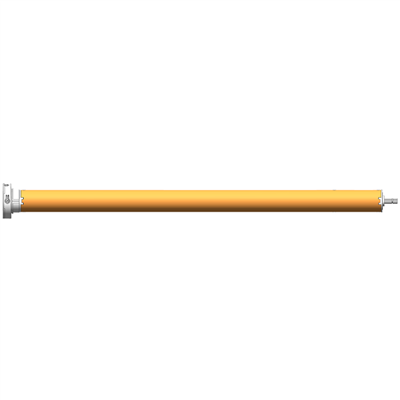
Hey there! As a supplier of Low Noise Tubular Motors, I often get asked about various technical aspects of these motors. One question that pops up quite frequently is, "What is the rotor inertia of a low noise tubular motor?" Well, let's dive right into it and break it down in a way that's easy to understand.
First off, let's talk about what rotor inertia actually means. In simple terms, rotor inertia is a measure of how resistant a rotor is to changes in its rotational speed. You can think of it like the "stubbornness" of the rotor to start spinning or to stop spinning once it's already in motion. It's determined by the mass of the rotor and how that mass is distributed around the axis of rotation.


For a low noise tubular motor, the rotor inertia plays a crucial role in its performance. A motor with a high rotor inertia will require more torque to start and stop quickly. This can be a good thing in some applications where you need smooth, continuous motion. On the other hand, a motor with a low rotor inertia can respond more quickly to changes in speed and direction, which is great for applications that require rapid acceleration and deceleration.
Now, let's get into the nitty - gritty of how rotor inertia affects the operation of a low noise tubular motor. When you turn on a tubular motor, the motor needs to overcome the rotor's inertia to start spinning. If the rotor inertia is too high, the motor might struggle to start up, leading to longer start - up times and potentially more wear and tear on the motor components. On the flip side, if the rotor inertia is too low, the motor might be more prone to vibrations and instability, especially at high speeds.
In our range of low noise tubular motors, we've carefully engineered the rotor inertia to strike the right balance for different applications. For example, our 45mm Manual Radio Tubular Motor is designed with an optimal rotor inertia for applications where you need a combination of manual and radio - controlled operation. The rotor inertia allows for smooth start - up and reliable performance, whether you're using the manual override or the radio control.
Similarly, our 45mm Manual Tubular Motor has been fine - tuned to provide the right amount of inertia for manual operation. This ensures that the motor is easy to control by hand, without being too sluggish or too twitchy.
And then there's our 45mm Electronic Radio Tubular Motor. This motor is designed for applications where you need precise electronic control. The rotor inertia is optimized to work in harmony with the electronic control system, allowing for accurate speed and position control.
So, how do we determine the right rotor inertia for our motors? Well, it's a combination of science and experience. We use advanced engineering software to model the motor's performance based on different rotor inertia values. Then, we test the motors in real - world conditions to make sure they meet our high standards of performance and reliability.
Another factor that affects rotor inertia is the materials used in the rotor. We use high - quality materials that are both lightweight and strong. This helps us to reduce the overall mass of the rotor without sacrificing its structural integrity. By carefully selecting the materials and the design of the rotor, we can achieve the desired rotor inertia while keeping the motor as efficient and quiet as possible.
In addition to the design and materials, the manufacturing process also plays a role in determining the rotor inertia. We use state - of - the - art manufacturing techniques to ensure that each rotor is precisely balanced and has the correct dimensions. This helps to minimize any variations in rotor inertia between different motors, ensuring consistent performance across our product range.
Now, you might be wondering how you can choose the right low noise tubular motor with the appropriate rotor inertia for your specific application. The first step is to understand the requirements of your application. Do you need a motor that can start and stop quickly? Or do you need a motor that can provide smooth, continuous motion? Once you have a clear idea of your requirements, you can take a look at our product range and see which motor is the best fit.
If you're still not sure which motor is right for you, don't worry! Our team of experts is always here to help. We can provide you with detailed technical information and advice to help you make the right decision. Whether you're a small business owner looking for a motor for a single application or a large - scale manufacturer looking for a reliable motor supplier, we've got you covered.
In conclusion, rotor inertia is a critical factor in the performance of a low noise tubular motor. By understanding how rotor inertia works and how it affects the operation of the motor, you can make an informed decision when choosing a motor for your application. Our range of low noise tubular motors, including the 45mm Manual Radio Tubular Motor, 45mm Manual Tubular Motor, and 45mm Electronic Radio Tubular Motor, are designed with the optimal rotor inertia for different applications.
If you're interested in learning more about our low noise tubular motors or if you're ready to place an order, we'd love to hear from you. Just reach out to us, and we'll be happy to discuss your needs and provide you with a quote. Let's work together to find the perfect motor solution for your project!
References:
- Engineering textbooks on motor design and dynamics
- Internal research and development reports from our company's motor design team