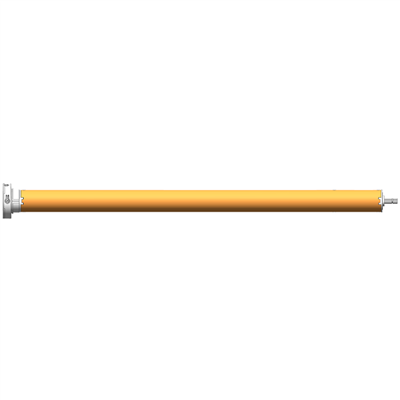
As a key component in modern automation equipment, tubular motors are widely used in electric curtains, rolling doors, projection screens and other scenes. Its compact structure and efficient power transmission characteristics make it an ideal choice for many industrial and home automation systems. This article will deeply analyze the working principle of tubular motors to help readers better understand its technical characteristics and application value.
The core structure of tubular motors includes motor body, reduction mechanism, stroke control device and housing. The motor body usually adopts DC or AC motor to provide initial power. The reduction mechanism reduces the speed and increases the torque through the gear set to ensure that the motor can drive the load smoothly. The stroke control device is responsible for accurately controlling the start and stop position of the motor to prevent overload or excessive operation.
During the working process, the tubular motor is first powered by the power supply, and the motor rotor begins to rotate. Since direct drive may not meet the load requirements, the reduction mechanism intervenes and converts the high-speed and low-torque motor output into low-speed and high-torque power output through multi-stage gear transmission. This process ensures that the motor can easily drive heavier curtains, door curtains or other rolling curtain equipment.
Stroke control is another important function of tubular motors. Through the built-in limit switch or Hall sensor, the motor can monitor the position of the roller shutter in real time and automatically stop when it reaches the preset open or closed position. This precise control mechanism not only improves the reliability of the equipment, but also extends the service life of the motor and transmission components.
In addition, tubular motors usually have overload protection. When the load exceeds the set value, the motor will automatically stop or reverse to avoid damage. This design enables it to maintain stable performance in complex use environments.
Tubular motors have become an indispensable part of automation equipment due to their high efficiency, compactness and reliability. With the continuous advancement of technology, future tubular motors are expected to achieve further improvements in energy efficiency and control accuracy, providing more optimized solutions for more industries.