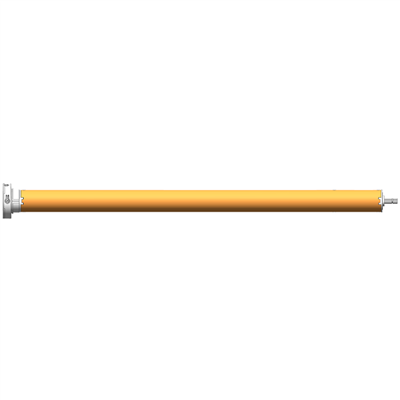
In the wave of modern building and home intelligence, tubular motors have become the core power units of electric curtains, awnings and other equipment with their compact structure and high reliability. Although this type of motor is small in size, it combines precision mechanical design and electronic control technology, and its internal structure directly affects the operating efficiency and service life of the equipment.
The core of the tubular motor consists of three modules. The power system is located inside the cylindrical metal shell, usually using a permanent magnet DC motor or AC motor, which converts high-speed rotation into low-speed high-torque output through a gear reduction mechanism. This design enables the motor to provide sufficient thrust in a limited space to meet the driving needs of heavy curtains or large sunshade fabrics. Some high-end products also integrate electromagnetic brakes to automatically lock the position when the power is off to prevent accidental sliding.
The transmission system is the key to connecting power and execution terminals. The precision-machined aluminum alloy or stainless steel tubular shell contains a multi-stage planetary gear set that can reduce the motor speed to several revolutions per minute while maintaining stable torque output. Some models use a double worm gear structure to enhance the self-locking performance, ensuring that the sunshade mechanism remains stationary at any position.
The control system gives the tubular motor intelligent features. The built-in microprocessor can receive wireless signals or wall switch commands, and monitor the motor speed and position in real time through the Hall sensor. The advanced closed-loop control algorithm can compensate for the error caused by mechanical gap and achieve precise positioning. Some products support 0-10V dimming signal or DALI protocol, which can be seamlessly connected with the building automation system.
With the development of Internet of Things technology, modern tubular motors are evolving towards integration. Sensor fusion technology enables the device to sense the ambient light intensity and automatically adjust the opening and closing amplitude, while the low-power Bluetooth module simplifies the installation and debugging process. These technological innovations not only improve the user experience, but also provide new solutions for building energy conservation. Understanding the structural principles of tubular motors will help buyers choose the most suitable product configuration according to actual application scenarios.